
Congratulations—you’ve taken a monumental step toward a healthier future. Getting a gastric band is often just the beginning of a transformative journey, but it’s crucial to understand that bariatric surgery isn’t a one-time fix; it requires ongoing fine-tuning. If you’ve heard terms like “fills” or “unfills,” you’re touching upon one of the most important aspects of living with an adjustable band: the adjustment process.
https://www.wupdoc.com/find/gastric-band-adjustment-t-423Unlike other bariatric surgeries, the gastric band system is designed to be fully customizable to your body’s needs. Weight loss is rarely a straight line, and as your body changes—losing weight, exercising more, or even dealing with stress—the feeling of “fullness” provided by the band can shift. This is where the crucial process of Gastric Band Adjustment comes in. Think of it like tuning a sophisticated instrument; to achieve the perfect harmony between effective restriction and comfortable eating, minor modifications are necessary.
A properly adjusted band is the key to sustained success. It ensures you feel satisfied with smaller portions without experiencing painful symptoms like reflux or regurgitation. Knowing when, why, and how these adjustments are performed empowers you to work collaboratively with your medical team and maximize your weight loss potential.
Lap-Band Fills: Optimizing the System
The term Gastric Band Adjustment often revolves around the process known as a “fill” or an “unfill.” These terms describe the non-surgical procedure used to change the amount of saline solution inside the band, thereby altering the tightness of the band around the upper stomach.
The band system works because it has a small internal balloon connected to a tube, which leads to an access port placed just under the skin, usually near your ribcage. When the band is first placed, it is often kept loose. Over the next few weeks or months, as you recover, your physician will begin to introduce sterile saline solution into the port using a specialized, non-invasive needle.
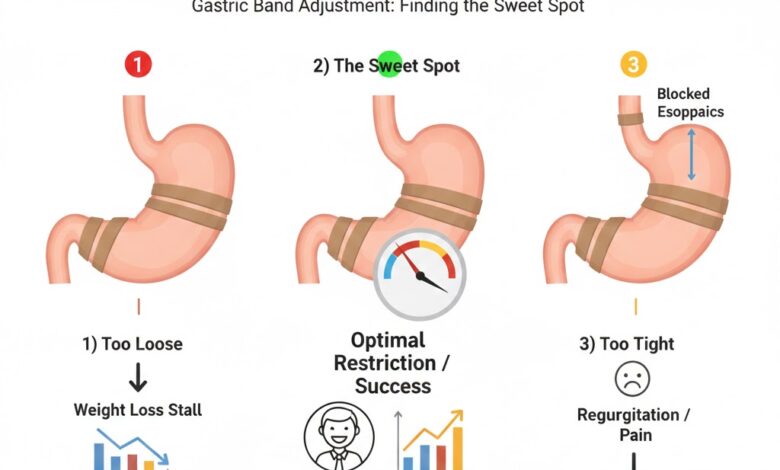
Why is this necessary? The goal is to create a small pouch at the top of the stomach, slowing the passage of food and making you feel full quicker. If there is too little fluid (loose band), you will be able to eat larger amounts and weight loss will stall. If there is too much fluid (tight band), you will experience discomfort and difficulty swallowing.
The Difference Between a Fill and a Unfill
A “fill” is when fluid is added to the band, increasing the restriction. This is typically done when you feel the band is too loose, you are frequently hungry, or your weight loss has plateaued. A “unfill” (or partial removal of fluid) is performed when the band is too tight, causing distressing side effects. Your clinician will assess your symptoms and determine the exact amount of fluid needed—usually measured in tenths of a milliliter—to achieve optimal restriction.
What to Expect During the Procedure
The actual adjustment procedure is quick, typically taking only a few minutes, and is performed in an outpatient clinic setting. You lie down, and the clinician locates the port using their fingers or sometimes an X-ray (fluoroscopy) to ensure accuracy. The area is cleaned, and a thin needle is passed through the skin into the port reservoir. You will likely feel a pinprick, but the process is generally not painful. If fluoroscopy is used, you may be asked to swallow a small amount of liquid to visualize how the fluid is changing the size of the stomach opening in real time.
Understanding Restriction: Finding Your Sweet Spot
The concept of “optimal restriction,” or the “sweet spot,” is fundamental to the success of the gastric band. This is the precise point where the band provides enough resistance to enforce small portion sizes while allowing you to eat healthy solid foods comfortably without constant nausea or vomiting.
Finding this sweet spot is highly personalized and takes time. It’s not about finding the tightest band setting possible; that will lead to nutritional deficiencies and uncomfortable eating habits. It’s about finding the balance that promotes healthy, steady weight loss.
Signs Your Band Needs a Fill
If your band is currently too loose, you might start noticing a return of old eating habits or a slowing down of your progress. Symptoms that often indicate the need for a fill include:
- Ease of Eating: You can easily consume normal-sized meals without feeling satisfied or full.
- Snacking Rebound: You find yourself grazing or frequently snacking between meals because you aren’t feeling adequately restricted.
- Weight Plateau: After an initial period of steady loss, your weight loss has stalled for several weeks despite adhering to your diet plan.
- Absence of Restriction: You rarely feel the sensation of the food slowing down or “catching” slightly at the top of the stomach.
Signs Your Band is Too Tight
When the band is too tight, your body will let you know quickly, often through uncomfortable symptoms related to the blockage of the food pathway. This is a sign that an unfill is necessary to prevent complications. Symptoms that require immediate attention include:
- Painful Swallowing or Dysphagia: Consistent difficulty getting food down, requiring large amounts of liquid to wash down even small bites.
- Regurgitation: Frequent, effortless spitting up of unchewed food (not vomiting). This happens because the food cannot pass through the tight opening.
- Nighttime Reflux or Heartburn: Severe, persistent acid reflux, particularly when lying down.
- Inability to Tolerate Solids: Being restricted primarily to soft or liquid foods because solids cause intense discomfort.
Timing Your Adjustments for Optimal Weight Loss
While adjustments can happen throughout the lifetime of the band, they are most common during the first 12 to 18 months following the operation. This is often referred to as the “titration” or “dialing in” phase. During this time, your body is undergoing significant weight loss, and regular check-ins—often every four to six weeks initially—are essential to keep pace with your changing anatomy and metabolism.
It is crucial to remember that weight loss results are not solely dependent on the tightness of the band. The Gastric Band Adjustment is a tool that supports behavioral changes. Maintaining open communication with your bariatric team about your eating habits, exercise routine, and any physical symptoms is the best way to determine the ideal timing and volume for your next adjustment. A successful adjustment works hand-in-hand with dietary compliance.
The gastric band is an amazing tool because it is fully adjustable, allowing you to fine-tune your weight loss journey over time. The key to sustained success lies in embracing the process of Gastric Band Adjustment. By recognizing the signs of too much or too little restriction, and by working closely with your surgical team during regular Lap-Band Fills, you can maintain the optimal level of restriction needed to curb hunger, control portion sizes, and continue achieving your long-term health goals. Don’t view adjustments as setbacks, but as essential opportunities to optimize your health.